The Paid Online German Lessons We Bought, as English-Speakers
Quick Take
Paying for online German lessons didn’t make us learn faster — it made us more intentional.
Some courses only became useful years after we bought them, once life in Germany slowed down and our brains had room to absorb the language.
If you’re considering paid German lessons, timing matters more than motivation.
Why We Started Paying for German Lessons
We didn’t start paying for German lessons because we were disciplined language learners.
We did it because we thought money might act as a shortcut.
I bought our first paid German lesson within one month of moving to Stuttgart. At the time, motivation was high, free time felt abundant, and it seemed reasonable to assume that structure — plus payment — would accelerate everything.
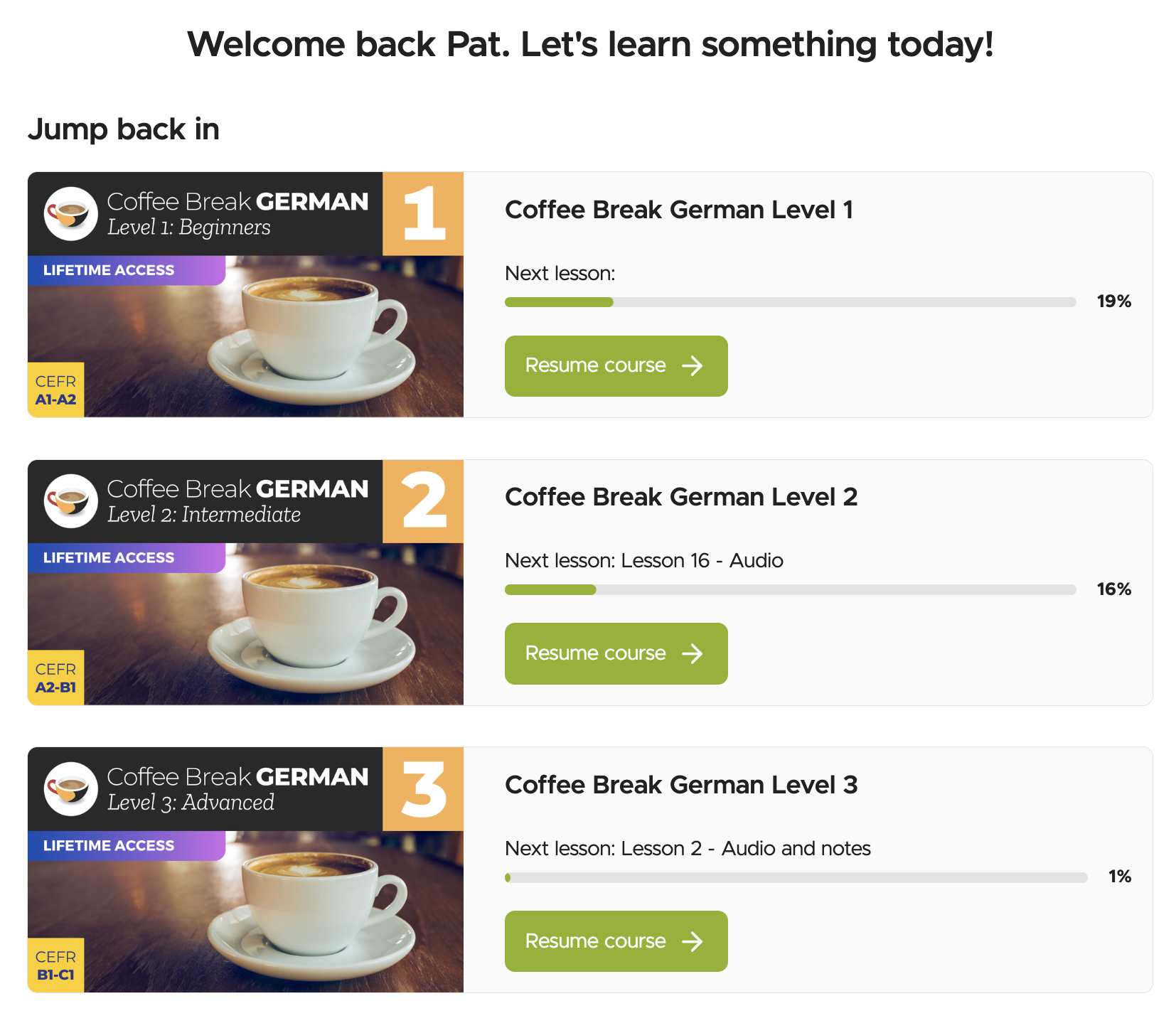
The first course I bought was Coffee Break German Level 1, followed by Levels 2 and 3 when they went on sale.
At that point, I had no German baseline. I’d only been casually listening to Coffee Break German’s free podcast on Spotify. Helpful, yes — but passive. In 2024, motivation was high, but language absorption was low.
Fast forward to 2026: motivation is lower, but learning is finally clicking. Those same Coffee Break German lessons feel completely different now. Two years ago, most of it went in one ear and out the other. Today, it actually sticks.
The difference wasn’t the course.
It was timing.
What Paying Actually Changed
Paying for German lessons didn’t raise our motivation — it raised our commitment.
Once money was involved, there was a quiet sense of responsibility: I paid for this, so I should show up. At the same time, I deliberately avoided subscription-based platforms. I didn’t want guilt-driven learning or the pressure of a ticking renewal date.
That’s why I chose one-time purchases like Coffee Break German and Learn German with Anja. They allowed us to learn at our own pace, without turning German into another source of stress.
The Paid Lessons We Tried
Coffee Break German (Levels 1, 2, 3)
Coffee Break German felt safe to pay for because I already trusted the teaching style. I’d been listening to the free podcast since we decided to move to Germany, and the tone felt calm, human, and approachable.
What stood out most is that you’re learning alongside Mark, not being lectured. You struggle, pause, repeat, and progress together. That made the process feel less intimidating — especially early on.
Most of my listening happened during my morning commute: on the U-Bahn or on ICE train rides between Stuttgart and Ulm. Mornings were for German. Afternoons were for unwinding with English playlists.
What surprised me is that the paid materials only really started working after nearly two years in Germany — once the constant stress of settling in and dealing with bureaucracy eased.
The paid package includes:
video transcriptions
audio lessons
bonus exercises
PDF study notes
All of that became valuable only when my brain finally had room to absorb it.
Learn German with Anja
I turned to Anja’s content out of frustration.
At first, I wasn’t picking up the concepts in Coffee Break German. I wanted something simpler — more beginner-friendly and more focused on fundamentals.
Anja’s 30-day challenge felt approachable, even though it still seemed difficult at the time. I also bought her lessons on der, die, das, which initially felt impossible.
Over time, something shifted. After living in Germany longer, patterns started to emerge: word endings, repetition, grouping. It’s still not easy, but it finally feels learnable.
This material only worked once I’d been exposed to German long enough to recognize those patterns.
Expertly German
Expertly German felt like the right next step — until it wasn’t.
After purchasing an annual plan, I quickly realized it was far more advanced than expected. As a beginner, it was simply too much. I cancelled the renewal after the first year.
This wasn’t a bad product. It just wasn’t right for where I was.
Once I reach a B2 level, I’d consider revisiting it — not to learn basics, but to refine and maintain fluency.
What All Paid Tools Had in Common
Paid tools didn’t accelerate our German.
They accelerated our realization that there are no shortcuts.
Money doesn’t replace:
mental clarity
time
repetition
active practice
Immersion helps, but it’s only part of the equation. Even now, I still rely heavily on free resources, especially conversational YouTube content and Deutsche Welle’s Nicos Weg series, alongside anything paid.
When Paying Makes Sense — and When It Doesn’t
You might be ready to pay for German lessons if:
free materials feel saturated
you already have a foundation and want structure
you’re preparing for an official language exam
paying helps you commit, not rush
You might want to wait if:
you’re still a casual learner
you’re just starting out
your life is already overloaded
If you’re planning to move to Germany for work, start with Coffee Break German’s free podcast. Only consider paying once visual transcriptions, lesson notes, and bonus material would actually support your learning.
The Real Takeaway
Paying for German lessons didn’t change how hard the language was.
It changed how intentionally we showed up — once our lives allowed us to.
In the next post, we’ll share how we practice German now, without burnout, pressure, or unrealistic expectations.