Deutsche Bahn Delays Explained: What to Do When Your Train Is Cancelled
Quick Take
Deutsche Bahn train cancellations don’t work the way many travelers expect.
If your ICE train is cancelled or delayed, you’re usually not automatically rebooked — even if you use the DB app.
You’re responsible for finding an alternative train, knowing when you’re allowed to take it, and understanding what happens to your seat.
This post explains what actually happens during a DB cancellation, what you’re entitled to, and how to handle delays with far less stress.
When the Plan Falls Apart
We assumed that if a train was cancelled, Deutsche Bahn would just put us on the next one.
That’s not how it works.
Over the years, I’ve dealt with plenty of last-minute ICE cancellations — when we first moved to Germany, when family visited, and on routine trips home from work.
Cancellations happen. And they’re stressful.
They’re even worse when you have a flight to catch at Frankfurt, heavy luggage, or a tight connection. I expected Deutsche Bahn to reroute me automatically.
That expectation came from North America.
With airlines like Air Canada or Delta, a cancelled flight usually means an automatic rebooking. You get a notification, a link, and options.
With Deutsche Bahn, it’s different.
When an ICE train is cancelled, you’re responsible for what happens next. If you’re unsure, go straight to a DB service desk or find a DB staff member in the station — immediately.
What Actually Happens During a Delay or Cancellation
Here’s what Deutsche Bahn does not do automatically.
They don’t rebook you.
They don’t assign a new seat.
They don’t guide you step by step.
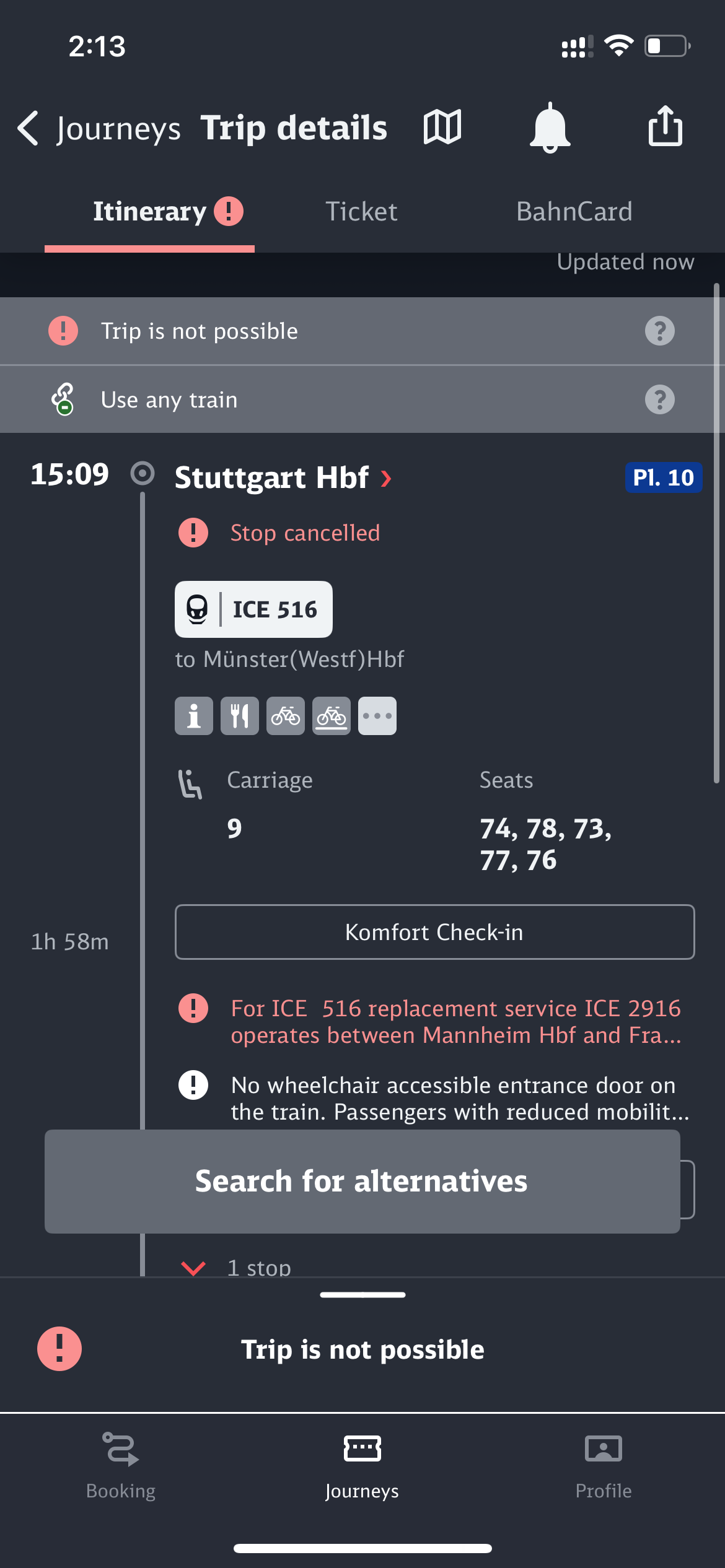
Even with the DB Navigator app, you’ll usually see a message like:
“Trip is not possible. Use any train.”
That’s it.
No guidance. No next steps.
If you’re not a frequent traveler, this is when panic sets in.
You’re suddenly answering questions on your own:
How do I get there now?
Which trains can I take?
Is my ticket still valid?
Do I need to buy a new one?
The first few times, this felt overwhelming.
Now my reaction is usually: here we go again.
What I do:
Open the DB Navigator app
Find the next ICE to my destination
Don’t buy a new ticket
Keep my original ticket
Board the next appropriate ICE
If anything feels unclear, I go straight to a DB customer service office.
What You’re Allowed to Do (And When)
This is the part most people don’t realize.
If your scheduled train is delayed by 20 minutes or more, or cancelled, you’re generally allowed to take another suitable train to reach your destination.
That flexibility comes with caveats.
Your seat reservation won’t carry over:
Car numbers may differ
Seats may already be taken
Replacement trains can be full
Standing for part — or all — of the journey is possible.
If you’re unsure, ask a DB staff member. It’s faster than guessing.
How We Handle Delays Now
After enough cancellations, we changed how we travel.
We assume delays are possible on every trip.
If one happens:
Check the DB Navigator app first
Go to a DB service desk early if things look messy
Abandon tight connections immediately
Choose a flexible plan over the original one
A few adjustments help:
With luggage: avoid packed replacement trains when possible
With flights: build buffer time and skip last-minute transfers
Late at night: get on any reasonable train moving you forward
Knowing when to stop forcing the plan reduces stress.
Delays Are Normal — Panic Is Optional
I now expect delays on every train trip.
It’s a win when everything runs smoothly — and often it does — but knowing how to handle a cancellation changes everything.
Understanding how DB actually works helps.
Avoiding tight connections helps more.
Knowing the 20-minute rule would’ve helped earlier.
One final surprise: fellow passengers usually won’t step in if you look lost. That’s not rudeness — it’s just how the system works.
If you need help, find a DB agent.
Once you accept that delays are part of the system — not a personal failure — everything gets easier.